Electric Trucks: Practical Testing in Logistics
Electric trucks are no longer a thing of the future; they are a reality in freight transport. Logistics companies like Emons are sharing their practical experiences with electric trucks in city logistics.
The silence emitted by a battery-electric truck as it glides through the city in the early morning is still unfamiliar to many. Yet, in the depots of German and European logistics companies, this silence is increasingly becoming the soundtrack of a transformation that is fundamentally changing freight transport. What was considered a niche product for urban distribution just a few years ago is now conquering larger segments of the logistics chain, thanks to increasing range and efficiency. The experiences of pioneers show: the electric truck is no longer a distant dream, but a practical reality that, however, requires a readjustment of processes and infrastructure.
The Quiet Advance into City Logistics
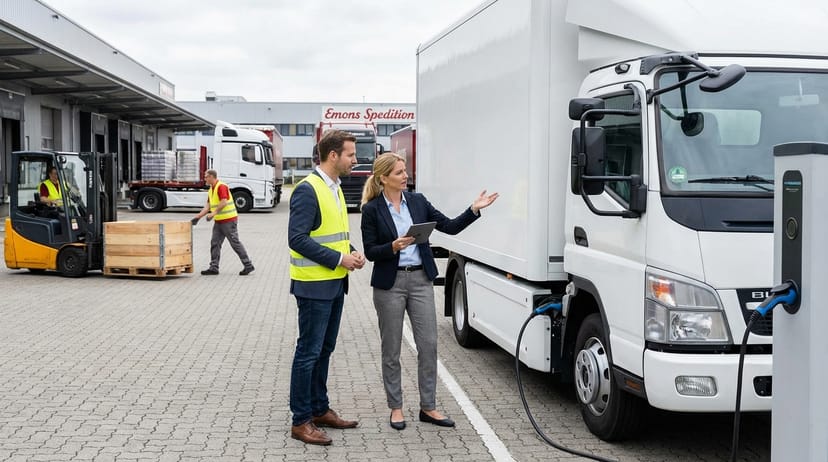
In Ditzingen, near Stuttgart, Emons Spedition has been operating a fully electric FUSO eCanter since June 2024, which delivers to Stuttgart's city center daily. "After about a year in operation, Emons reports a positive outcome," the company states. The electric truck completed 164 tours with a total mileage of 12,571 kilometers, significantly exceeding the project goal. On average, the eCanter covered 77 kilometers per tour, transporting around 2.5 tons of goods for textile shops and small businesses. Thanks to certified green electricity, 100 percent of the CO₂ emissions that a comparable diesel truck would have caused were saved.
However, the path was not without its hurdles. Emons had to finance the charging infrastructure out of its own pocket, as an application for a subsidized charging station was rejected because the location was a few meters outside the city limits. Rüdiger Bausch, branch manager at Emons, is pleased, however, that the battery is fully charged again after 3.5 hours using pure green electricity, and he emphasizes the higher quality of life due to less noise and exhaust fumes.
Kühne+Nagel is also increasingly focusing on electromobility in short-haul transport. In August 2024, the logistics service provider expanded its fleet by another six fully electric Renault Trucks E-Tech D 16 4x2, which are being used for freight transfer at various locations in Germany. One vehicle had already been successfully tested in Hamburg for over a year. "It is our corporate responsibility to actively drive decarbonization in logistics," explains Tobias Jerschke, CEO of Kühne+Nagel Germany.
Mid-Range as the "Sweet Spot"
While city traffic is a natural domain for electric trucks, the boundaries of practical suitability are increasingly shifting into the mid-range sector. Modern electric trucks now offer ranges between 300 and 500 kilometers, which, according to experts, is sufficient for about two-thirds of all truck traffic in Germany.
DACHSER, a pioneer in the industry, put its 100th electric truck into operation in January 2025 – a Volvo FL Electric 16-tonner with a refrigerated body that delivers fresh food to Hamburg and the surrounding area. Christoph Kellermann, Operations Manager European Logistics at the DACHSER logistics center in Hamburg, is convinced: "The vehicle shows that e-mobility in logistics is coming of age and that perfectly practical solutions are now available for food logistics or general cargo long-haul transport."
The Dortmund branch of DACHSER uses three battery-electric trucks, including two 42-ton Volvo FH Electric models. These vehicles are used during the day for local shuttle services for customers and perform round-trip services to other DACHSER branches at night. In 24-hour operation, the two Volvos each cover up to 600 kilometers – without intermediate charging on the route, as the routes are precisely tailored to the vehicles' range.
The Janssen logistics company from Leer has also initiated a remarkable transformation. Nanno Janssen, head of the eponymous company, reports that 13 electric trucks are already in operation and 44 more have been ordered for 2025. "In total, we have ordered 44 electric trucks for this year, and 13 of those are already here," says Janssen. He adds: "By the end of the year, we will be at 40 percent electric trucks, with the trend, of course, continuing to rise." For him, the electric truck is the most sustainable solution and, from a business perspective, "not far off" from diesel vehicles, especially due to the toll exemption.
Long-Haul Transport – A Question of Planning and Infrastructure
Long-haul transport is considered the last bastion of the diesel engine, but even here, the limits are increasingly being tested. DB Schenker is not afraid to put new electric models through their paces. In May 2024, the group tested a Scania R450e, weighing up to 64 tons and 24 meters long, on a regular long-haul route in Sweden. With an additional battery pack, the electric truck completed a route of about 300 kilometers between Jönköping and Södertälje without intermediate charging.
In January 2025, DB Schenker received the first ten of a total of 100 MAN eTGX Ultra tractor units, which are to be integrated into the fleet by 2026. These vehicles are specifically designed for high loading volumes and allow the use of mega-trailers with an internal height of three meters. Marc Pühler, Senior Vice President System Operations at DB Schenker in Europe, highlights that the eTGX are used in daily line-haul operations in the general cargo network in two-shift operation, for example, in a round trip between two terminals.
DACHSER completed a particularly ambitious project in November 2024: A Renault Trucks E-Tech D from Bad Salzuflen drove to Hungary for a charitable cause – a distance of 2,100 kilometers round trip. Matthias Syrbe, who works in dispatch, was initially apprehensive about the long journey, but the careful planning of charging times and options along the route dispelled all concerns. "Based on the information we had, regarding charging time, batteries, range, and vehicle technology – combined with the charging options along the route – I had no concerns at all," says Syrbe.
Schlager Transport Logistik GmbH in Austria has used five electric trucks to cover over a million kilometers in everyday operations over 20 months, saving 240,000 liters of diesel. 60 percent of the electricity comes from their own photovoltaic system. "We cannot drill for oil on our company premises, but we can produce electricity. That is a real game changer," emphasizes Managing Director Hubert Schlager. The vehicles operate with a range of about 500 kilometers per charging cycle and cover 400 kilometers again after about 60 minutes of fast charging. By 2030, the entire fleet is expected to be emission-free.
The Challenge of Charging Infrastructure and Optimized Processes
The success of battery-electric trucks depends significantly on a robust charging infrastructure. Nanno Janssen from the Janssen logistics company gives a drastic piece of practical advice: "Don't try it, because it's a nightmare for everyone involved." He speaks of the difficulties when one's own charging infrastructure is not yet functional and one is dependent on public charging points.
Many logistics companies are therefore investing heavily in their own charging solutions. The W&P logistics company in Prenstadt, for example, has invested 19 million euros in 56 charging stations, some of which are powered by their own solar energy. Owner Alexander Wer hopes for a "barter system" with other logistics companies until the public charging infrastructure is sufficiently developed.
At the European level, however, expansion is being pushed forward. The EU Commission has set concrete minimum targets for public truck charging infrastructure: by 2025, charging stations with a capacity of 1.4 megawatts are to be built every 60 kilometers along the main transport axes. Companies like Milence are investing 500 million euros to build 1,700 public charging stations with megawatt charging capabilities by 2027. A consortium of E.ON, Voltix, and GreenWay is also planning charging hubs with at least one megawatt of power along the most important European transport corridors.
In addition to hardware, intelligent planning is crucial. A study by the Fraunhofer Institute for Systems and Innovation Research (ISI) and the Swedish transport technology company Einride, based on over 38,000 delivery trips by the retail company REWE, shows: software-supported optimization of route and charging planning at the fleet level can significantly increase the share of electrified truck trips while simultaneously reducing costs. Instead of replacing diesel trucks 1:1, which would only move 57 percent of goods electrically, up to 85 percent of the transported goods volume can be moved electrically with optimized planning.
Conclusion: The Future is Electric – With a Smart Approach
The experiences of logistics companies with battery-electric trucks are extremely positive where the framework conditions are right. Electric trucks are ideally suited for:
- City logistics and regional distribution: Here, they fully utilize their strengths such as zero emissions, low noise, and sufficient range.
- Mid-range routes with plannable routes and depot charging: With ranges of 300 to 500 kilometers, they cover a large part of daily transport needs, especially if charging can take place overnight at the depot.
- Volume transport: Thanks to special lowliner tractor units, large volumes can also be transported electrically.
- Specific long-haul and line-haul operations: On fixed routes with established charging points or through careful planning and intermediate charging, longer distances are already feasible.
The transformation will not be linear. Acquisition costs are still higher than for diesel vehicles, but total cost of ownership (TCO) can already be competitive due to lower energy costs (especially with one's own green electricity) and toll exemptions. A study by PwC Strategy& predicts that in 2030, one in five trucks worldwide will be battery-electric, and that by this time at the latest, electric trucks will beat combustion engines in terms of TCO.
The key to success lies in the intelligent integration of vehicle technology, charging infrastructure, and adapted logistics processes. Logistics companies that actively tackle this challenge and invest in the electrification of their fleets and the necessary digital planning will not only make an important contribution to climate protection but will also secure decisive competitive advantages. The quiet giants of the road are on the rise.
Sources:
- emons.de
- emons.com
- electrive.net
- kfz-anzeiger.com
- sciencemediacenter.de
- iodynamics.de
- handelszeitung.ch
- trans.info
- electrive.net
- youtube.com
- electrive.net
- ecomento.de
- trans.info
- dachser.de
- meinbezirk.at
- youtube.com
- enbw.com
- uta.com
- motormobiles.de
- solarserver.de
- fraunhofer.de
- elektroauto-news.net
- brummionline.com
- dachser.de
- ecomento.de
- electrive.net
- pwc.com
- dbschenker.com
- elektroauto-news.net
- cleanthinking.de