Container Services: Fully Digital Weighing Processes
Paper slips, phone calls, and WhatsApp photos slow down the weighbridge. A QR-based web app connects drivers, the yard, and the ERP in a single process.
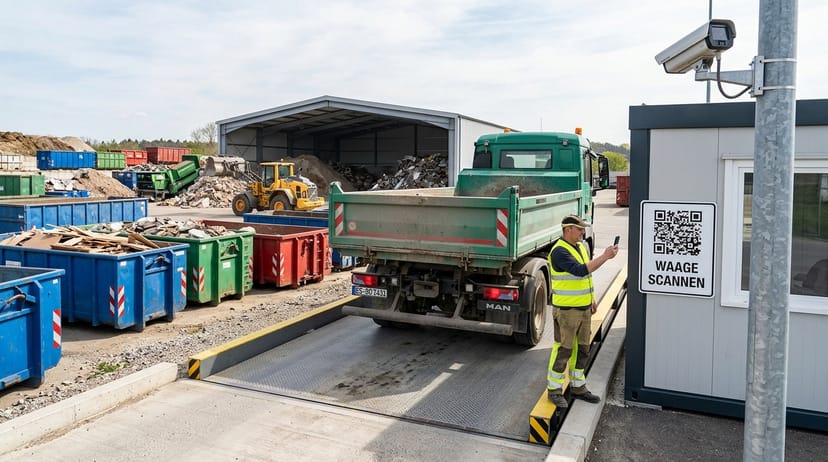
Every weighbridge in a container service is ultimately a bottleneck: two weighings per load, a paper slip, a call to the office, a few WhatsApp photos from the yard—and if everything goes well, it all ends up neatly in the ERP system's fast weighing module by evening. In practice, this mix of media costs minutes per truck, leads to follow-up questions, and keeps the scale staff tied to the phone almost exclusively. A cleanly designed digitalization approach cleans up this mess without replacing the industry's entire toolkit.
At a glance: Weighing in the container service industry currently relies on paper slips, phone calls, and WhatsApp. A weatherproof QR code at every scale leads drivers and yard staff into the same web app, which connects license plate recognition and fast weighing (e.g., David 2R). The result: a single session ID per load, no paper, and significantly less stressed scale personnel.
The Weighbridge as a Bottleneck
Container services and secondary raw material traders work within a tight regulatory framework. Section 50 of the German Circular Economy Act (KrWG) obliges waste disposers, transporters, dealers, and brokers to maintain registers of the origin, quantity, nature, and whereabouts of waste [1]. Parallel to this, the Physikalisch-Technische Bundesanstalt (PTB) oversees the calibration of non-automatic scales in commercial transactions—vehicle scales in waste management operations are subject to mandatory calibration and must generally be recalibrated every three years [2]. Every weighing is thus both a basis for billing and a verification document. Anyone who manages the leap from paper and WhatsApp to a continuous digital trail solves a problem familiar to many industries—the parallels to our maintenance app for refrigeration and air conditioning are obvious. In reality, however, the situation at the scale often looks like this:
- The external driver drives onto the scale, gets out, and calls the office.
- The scale staff manually types the company, license plate, construction site, and material into the fast weighing system.
- The driver is given a paper slip, which the yard worker declares by hand.
- The declaration and photos of the load are sent back to the scale via WhatsApp.
- There, images and the form are attached to the order, and storage locations and materials are manually updated.
Every single step is understandable—but in total, it creates a fragile process involving four media (phone, paper, WhatsApp, ERP) and three roles. Even illegible handwriting or a misassigned photo costs research time and delays the invoice. For companies operating several locations in parallel, the effort per scale multiplies.
The Digitalization Index 2024 from the German Economic Institute (IW Köln), prepared on behalf of the Federal Ministry for Economic Affairs and Climate Action, confirms that the industry has catching up to do: the "Construction, Supply, and Disposal" industry group scores 67.6 points, noticeably below average, and shows only slight growth [3]. At the same time, associations such as the bvse (most recently with the BVSE Digital Summit 2025 and the strategic cooperation with the "Entsorger Circle") [4] and the BDE in its position paper on digitalization [5] emphasize that mobile IT systems and a clean coupling of data and material flows are the keys to more efficiency and transparency in the circular economy. The weighbridge is exactly where both flows physically converge.
The QR Code Replaces the Industrial Tablet
The obvious reflex—bolting a kiosk terminal or an industrial tablet to every scale—is expensive, maintenance-intensive, and quickly fails in frost, rain, and dust. A more elegant variant uses the hardware the driver already has in their pocket:
A weatherproof QR code sign hangs at every scale. The driver scans it with their own smartphone and lands in a mobile web app. No app store installation, no registration, automatic language detection (optionally with voice dialogue for non-German speaking drivers). The web app looks the same on a private phone as it does on the yard worker's company phone—and that is the real lever: driver and yard work on the same session, not on separate forms.
If you still prefer a tablet or a kiosk, you can use the same web app there. However, the QR variant is almost always the faster answer: no device that breaks, no support case when the touchscreen acts up in winter.
License Plate Recognition and Fast Weighing: The Order Opens Automatically
Most container services already operate automatic license plate recognition (ANPR) at their scales. Today, this data is often "just a log"—it is rarely used to its full potential. This is exactly where the principle we describe in the article "AI captures orders automatically" comes in: feeding the recognition signal directly into the process instead of leaving it as raw data. Via an interface to the ERP—such as the David 2R fast weighing or a comparable scale module, built according to the guidelines of our System Integration Best Practices—a lean flow can be built from this:
- The truck drives onto the scale; ANPR recognizes the license plate.
- The backend opens the matching order (based on the order number for internal drivers, or vehicle history for external customers).
- The web app only asks the driver for what isn't already known automatically: company for first-time visits, construction site for third-party material, rough material declaration.
- The driver taps "Request initial weighing"—the fast weighing system records the data set, and the weight from the bridge flows directly into it.
For internal drivers, this completely eliminates the call to the scale. For external cash payers, only identification remains—often taking less than a minute instead of several minutes on the phone. Regular customers with a customer number are immediately recognized after the first scan with auto-complete—the same patterns we use for capturing address data automatically apply here: suggesting a delivery address from the debtor history is faster and less error-prone than any new entry.
Yard Staff: No More WhatsApp Photos
The classic media break does not occur at the scale, but between the scale and the yard. Today, the yard worker documents the declaration on a paper slip, takes photos, and sends everything back to the scale via WhatsApp. This is pragmatic—but borderline in terms of data protection (private messaging account), not audit-proof, and means double entry in the ERP.
In the digital process, the yard worker opens the same web app on their company phone, filters by storage location, and sees all open sessions for their scale. They select the correct process (or scan the license plate at the container), fill out the pre-filled digital slip, and photograph the material directly from the app. The photos are attached to the weighing record without detour, the declaration ends up structured in the ERP's material field, and the storage location is validated upon saving.
This not only eliminates the paper but also the intermediate transmission layer. For process owners, this is the real gain: every process has a continuous audit trail, including photos with timestamps, without anyone having to "quickly update the system later."
One Session ID Instead of Slips, Receipts, and Calls
The structural simplification lies in a single number: the session ID per weighing (e.g., W14-4821). It replaces the paper slip at external scales, the printed receipt for internal drivers at secondary locations, and the telephone inquiry during the second weighing. The driver returns to the scale, opens the same session via the QR code (or the last link in their browser history), confirms the declared material, and taps "Start return weighing." The bridge provides the second weight, the weighing slip is generated digitally and sent as a PDF or displayed in the app.
This not only closes a gap but eliminates an entire class of errors: no lost slips, no receipts falling out of the driver's cab, no confusion between two trucks with similar orders.
What Stays Manual by Design
Full automation is not an end in itself. In the first stage of expansion, one step intentionally remains at the office PC: cash payment. If a customer pays on-site with cash or a debit card, the app displays "Please go to the office for payment," and the scale staff completes the transaction at the checkout—with approval, invoice, or receipt printing. This deliberate boundary has two reasons: it keeps cash and calibration law issues cleanly separated, and it forces the brief eye contact between the customer and scale personnel, which is worth a lot in cases of dispute.
Similarly, the decision about a paper fallback (printed receipt for the yard) is made organizationally, not technically: if a location currently has the receipt firmly integrated into its workflow, the app continues to print it—but as a byproduct of the digital process, not as the primary document.
Frequently Asked Questions
Why not just bolt a tablet to every scale?
Tablets and kiosks at truck scales are exposed to high stress: frost, rain, dust, vibration, and accidental contact with truck tarpaulins. They fail regularly, require support, and lock the system into a specific hardware generation. A QR code sign is weatherproof, does not depend on power, and scales to any number of scales without building up inventory. For companies already using tablets, the same web app continues to run there.
Can this be integrated into an existing fast weighing system like David 2R?
Yes, provided the provider offers an interface for creating and updating weighings. The web app handles identification, declaration, and status management and passes the data to the fast weighing system, which remains the leading system for weighing slips, invoicing, and calibration law. For older on-premise installations, a thin adapter service is recommended, as described in our article on connecting legacy ERP systems.
How do we handle non-German speaking drivers?
The web app automatically detects the smartphone's system language and offers multi-language interfaces. For drivers who prefer not to type, a voice dialogue can be activated: "Who are you? From which construction site? What material?"—the answers are transcribed in real-time using modern AI voice recognition and displayed for confirmation. We describe how robust this pipeline has become in our article on the audio-to-text converter. This significantly lowers the entry barrier and is the reason many customers finally replace the paper slip.
Key Takeaways
- QR instead of Kiosk: A weatherproof QR code sign at every scale replaces expensive tablets and leads drivers into a mobile web app without app store installation.
- One Session per Load: License plate recognition and ERP connection open the correct order automatically; a single session ID replaces slips, receipts, and phone calls.
- Yard in the Same App: Yard staff declare digitally and attach photos directly to the weighing record—the WhatsApp workflow is completely eliminated.
- Deliberate Boundaries: Cash payment and checkout processing remain in the office; the paper fallback can be maintained but is no longer the primary document.
- First Step: Start with a single scale and a single use case (e.g., internal drivers) before rolling it out to external customers, recovery sites, and cash payers.
Sources
- Federal Ministry of Justice: Circular Economy Act (KrWG), Section 50 Registration Obligations, gesetze-im-internet.de.
- Physikalisch-Technische Bundesanstalt (PTB): Weighing at a Glance — Mandatory Calibration of Non-Automatic Scales in Commercial Transactions.
- German Economic Institute (IW Köln) on behalf of the Federal Ministry for Economic Affairs and Climate Action: Digitalization Index 2024 — Results Report (Long Version, PDF).
- bvse — Federal Association for Secondary Raw Materials and Waste Management: BVSE Digital Summit 2025 — Opportunities, Strategies, and Innovations for the Recycling and Waste Management Industry.
- BDE — Federal Association of the German Waste, Water, and Raw Materials Management Industry: Digitalization in the Circular Economy (Position Paper).