For those in a hurry
- E-Invoicing mandate from 2025: Companies working with public sector clients in the EU must send e-invoices starting in 2025 – a challenge that can be overcome without major system changes.
- Cloud-based software – Simple and seamless: Our solution enables the creation and receipt of e-invoices such as XRechnung and ZUGFeRD without needing to adapt existing systems. Everything works flexibly via the cloud.
- Automation saves time and reduces errors: Automated processes accelerate invoice processing and minimize errors while ensuring legal requirements are met effortlessly.
- Flexible, secure, and cost-efficient: Our cloud-based solution offers scalable billing models, GDPR-compliant security, and easy integration into existing systems.
The e-invoicing mandate is approaching – from 2025, companies doing business with public sector clients in the EU must transmit e-invoices. At the same time, companies must be able to receive and process e-invoices if requested by customers. The challenge lies in creating and receiving invoices digitally while complying with the XRechnung and ZUGFeRD formats. Many companies are wondering how they can adapt their existing software to use e-invoices without making large investments in new systems. With our cloud-based software solution, we offer a simple and efficient way to meet these requirements while benefiting from automated processes.
For more information on the mandatory introduction, associated transition rules, deadlines, and accepted formats, please see our article "Latest: Electronic Invoicing (E-Invoicing) from 2025".
Why is e-invoicing important?
The legal obligation for e-invoicing is intended to make administrative processes in companies and public authorities faster and more error-free. The XRechnung and ZUGFeRD formats ensure that invoices are transmitted digitally and in a standardized manner. This transition aims to reduce both paper usage and manual work steps.
However, many companies are concerned about whether they need to adapt their existing invoicing processes or source systems. The good news: You can receive and create e-invoices in the cloud without making changes to your existing systems. Discover the benefits of our E-Invoicing-as-a-Service for modern and uncomplicated invoice processing.
The importance of cloud-based software
Cloud-based software refers to programs provided over the internet rather than being installed locally on a computer. This allows users to access the software from different devices without having to worry about technical infrastructure or maintenance. SaaS (Software-as-a-Service) models regularly provide automatic updates, data backups, and flexible usage – also known as pay-as-you-go. The software is always available via an internet connection, which is particularly advantageous for services such as e-invoicing.
Our solution: Create e-invoices in the cloud
Our flexible solution for e-invoice creation is precisely tailored to the requirements of modern companies. With us, you can create and distribute valid e-invoices from existing systems – whether from Excel, PDF, databases, or ERP systems.
We offer you a fully cloud-based e-invoicing software that integrates seamlessly into your processes and meets all legal requirements.
1. Create e-invoices from various sources
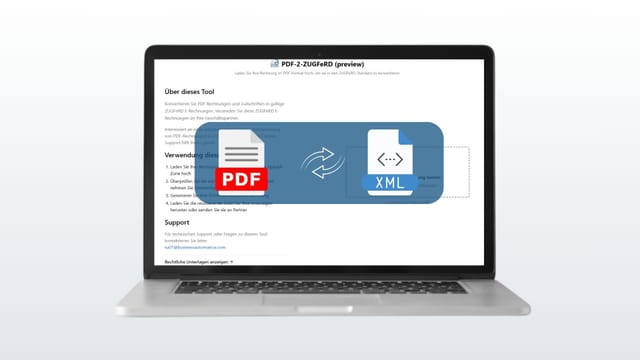
Regardless of which systems you currently use – with our solution, you create e-invoices in the cloud. There is no need to modify your source system. Our service enables you to generate XRechnung and ZUGFeRD formats directly from your data sources and also supports all relevant European invoice formats as well as receiving and sending channels.
2. Automatic distribution and archiving of e-invoices
Your e-invoice can be distributed easily and efficiently via email, on a file server, or via an API (interface). Archiving is also cloud-based, ensuring all data is secure and accessible at any time. This saves time and reduces sources of error.
3. Cloud-based e-invoicing software for maximum flexibility
Our solution is based on the cloud, meaning you don't have to build or maintain your own infrastructure. By using AWS Lambda and Workato, your e-invoices are created, validated, and sent in real-time – all in compliance with EU-GDPR and under the highest security precautions. And if you decide to switch to another provider in the future, we offer the option to migrate the solution to alternative cloud environments. Additionally, all e-invoices can be stored in existing Document Management Systems (DMS).
Use cases that optimize your invoicing processes
With our e-invoicing service, you can do more than just create e-invoices. We offer comprehensive automation that processes both outgoing and incoming invoices efficiently:
- Create and send XRechnung and ZUGFeRD: Use existing data from ERP systems, Excel, or databases to create compliant e-invoices in XRechnung or ZUGFeRD formats. Our solution handles validation and transmission.
- Process incoming e-invoices: Our cloud-based service also supports you in validating and automatically processing incoming invoices in XRechnung or ZUGFeRD format. This saves time and costs and avoids manual errors.
"Cloud-based solutions are particularly advantageous for companies seeking flexibility and scalability. They enable rapid implementation and reduce maintenance and infrastructure overhead."
Technical requirements and flexible cost models
Our e-invoicing solution is flexible and scalable. All components are designed to be easily adapted or replaced if new requirements arise or costs need to be reduced. Thanks to our e-invoicing platform, you can ensure that all processes run efficiently and cost-effectively.
Benefits of cloud-based software
- Cost-efficient implementation and low effort: Implementation requires moderate investment and is straightforward.
- Compatible with existing systems: Our solution integrates seamlessly into your existing software systems.
- Reduced error rate: The use of AI and automation significantly reduces the susceptibility to errors.
- Compliance with all legal requirements: Both German and EU-wide regulations (B2G, B2B) are fully met.
- Ideally suited for SMEs: Small and medium-sized enterprises, in particular, benefit from the simple implementation.
We offer various billing models: You can pay per created e-invoice, per received document, or according to other criteria. This flexibility ensures that you always maintain full control over your costs.
Conclusion
The transition to e-invoicing is a major challenge for many companies. With our solution, you benefit from cloud-based software that allows you to create e-invoices simply and efficiently. Complex system adjustments or investments in new infrastructure are not necessary. Instead, you and your employees benefit from automated processes, flexible scalability, and fast integration. Continuous review and adaptation of the solutions used to meet your company's current needs is important. Working with an experienced provider can be decisive in further simplifying and improving the process.
Contact us without obligation and find out how easy the transition can be for your company. With Business Automatica, you are choosing a solution that saves you time, money, and resources.
Frequently Asked Questions
Is using a cloud solution for e-invoicing secure?
Yes, using a cloud solution is secure because the data is hosted in audited data centers. Regular updates and maintenance of the software by the provider also ensure a high level of security.
What role does the cloud play in the implementation of e-invoices?
Implementing a cloud solution for e-invoices is often easier and faster because no extensive on-site IT infrastructure is required. Data is hosted in secure data centers, offering seamless collaboration between different departments.
How does automation work with e-invoices?
Algorithms automatically check invoice data for accuracy and completeness. This not only facilitates analysis but also reduces manual effort and the likelihood of errors.
Can an existing IT infrastructure be combined with a new e-invoicing solution?
Yes, most cloud solutions for e-invoices are designed to work seamlessly with existing IT systems such as SAP or other ERP systems. This often requires only minimal adjustment to ensure optimal functionality.
What steps should be considered when implementing an e-invoicing solution?
Implementation typically takes place in five steps: needs analysis, selection of the appropriate solution, software adaptation, team training, and finally, regular software maintenance after commissioning.