
The German government's Growth Opportunities Act (Wachstumschancengesetz) makes e-invoicing mandatory for all companies in Germany starting in 2025. The Federal Ministry of Finance has approved XRechnung and ZUGFeRD (from version 2.0.1) as the official formats. What does this mean for companies, especially small and medium-sized enterprises (SMEs)? How can you make your ERP system e-invoice compliant as easily and cost-effectively as possible?
Automated invoice processing and exchange with business partners is a standard business procedure—but unfortunately, it is also very complex and expensive. In most cases, the invoice issuer converts digital invoice data into analog formats like PDF, TIFF, or even paper, which the recipient then often has to laboriously or manually transform back into digital information. The federal government aims to put an end to this by 2025. E-invoicing is intended to improve invoice processing, reduce costs, and simplify oversight for tax authorities.
E-Invoicing Explained Simply
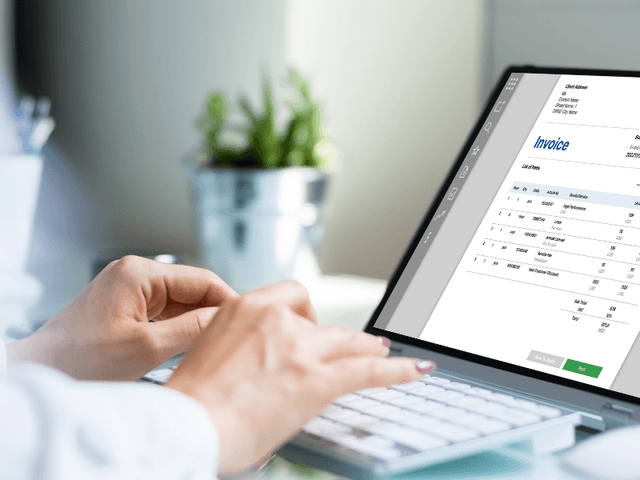
An e-invoice is a text document in which invoice items and other necessary details of a proper invoice are contained in a machine-readable, predictable, and structured format. Every field is defined—e.g., "Invoice Number"—so that a program can rely on that field always containing the same type of information.
The Federal Ministry of Finance has settled on two formats:
- XRechnung - mandatory for invoices to public institutions since 2021
- ZUGFeRD from version 2.0.1 - common in eCommerce
If a document is created in one of these two standard data structures, it can also be signed by the issuer, making it tamper-proof.
The XRechnung
The XRechnung is an XML file that must be structured according to a specific schema. Each field has a specific name dictated by the XRechnung standard, followed by the field value, e.g., "Invoice Number" "RE-2023-12-0254". Because the structure is fixed and uniform, any program that follows this standard can read the invoice information without difficulty.
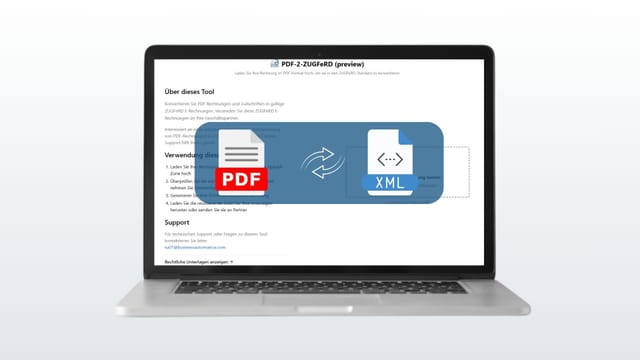
Additionally, an XRechnung viewer program can be used to generate a human-readable PDF file from the XML file. However, the XML file remains the authoritative version.
Other documents, such as proof of performance or delivery notes, can also be embedded into the XRechnung. They are stored using base64 encoding, a sequence of numbers also used on the internet for transmitting images within emails.
The ZUGFeRD Format
What sounds like a relic from pre-industrial agriculture (and is called Faktur-X in France) is very similar to XRechnung but expands upon it. A ZUGFeRD invoice is a human-readable PDF document with an embedded XML file for machine readability. This offers two advantages:
- A ZUGFeRD invoice can be read by humans just like a normal PDF invoice.
- Any computer program that implements this standard can read the XML file hidden within the PDF.
Consequently, the ZUGFeRD standard eliminates the need for subsequent generation of a human-readable PDF document, as it is created simultaneously with the ZUGFeRD invoice.
Integration into ERP Systems
We assume that major ERP system manufacturers like SAP S/4, Oracle Fusion, or Microsoft Dynamics will provide e-invoice-compliant functionality. Our solution is aimed at companies whose ERP does not offer this functionality or who cannot use their e-invoicing module for some reason.
In doing so, we follow the principle of least intervention in existing IT systems: you don't want to launch a massive IT project.
Our e-invoicing service relies on the following components:
- Flexible connection options to your ERP; we use one of the most modern iPaaS services with unlimited technical capabilities, ensuring that any customer can be connected without issues.
- Reliable XRechnung and ZUGFeRD software for creation and reading, which is regularly tested for security vulnerabilities and functionality, and always complies with legal requirements.
- Seamless logging of all processes in a tamper-proof, GoBD-compliant database, ensuring all transactions remain traceable even years later.
- Unlimited expansion possibilities due to a modular, standards-oriented cloud architecture that adapts to the dynamics of business life.
Finally, it should be mentioned: any solution is only as good as the people behind it. That is why we place the greatest importance on crystal-clear communication, stringent project management, and first-class customer service.