E-Invoicing Mandate 2025: What Businesses Need to Know
The e-invoicing mandate is coming in 2025. Learn about the applicable requirements and how to optimally prepare your company.

Das Wichtigste auf einen Blick
- As of Jan 1, 2025: All B2B companies must be able to receive e-invoices
- No ERP migration required: Add-on solutions make legacy systems compliant
- Rapid implementation possible: 2-4 weeks instead of months of ERP migration
- Accepted formats: XRechnung and ZUGFeRD 2.x meet the requirements
Electronic invoicing will become mandatory for B2B transactions in Germany starting in 2025. This transition affects virtually every company—from sole traders to large corporations. It is time to prepare.
What is an e-invoice?
An e-invoice is more than just a PDF sent via email. It must be provided in a structured, machine-readable format that enables automatic processing.
E-invoice according to EU standard EN 16931: An e-invoice is a structured electronic document that can be processed automatically without manual intervention. In Germany, XRechnung (pure XML) and ZUGFeRD 2.x (PDF with embedded XML) are the recognized formats. A simple PDF file does not qualify as an e-invoice.
Accepted formats
- XRechnung: The German standard, based on the EU standard EN 16931
- ZUGFeRD 2.x: Hybrid format with PDF and embedded XML data
- Peppol BIS: European standard for cross-border transactions
The e-invoicing mandate timeline
As of January 1, 2025
- All companies must be able to receive e-invoices
- No exceptions for small businesses
Transition periods for sending
- Until the end of 2026: Paper and PDF invoices remain permitted
- Until the end of 2027: PDF permitted only for annual revenues under €800,000
- From 2028: Full e-invoicing mandate for everyone
Technical requirements
Receiving e-invoices
- Email inbox: At least one dedicated inbox for e-invoices
- Processing software: Ability to read XRechnung/ZUGFeRD
- Archiving: GoBD-compliant storage
Sending e-invoices
- Invoicing software: Must be able to generate structured formats
- Validation: Verification against the EU standard EN 16931
- Transmission: Via email, Peppol, or portal
The benefits of e-invoicing
For the issuer
- Faster payment: Automatic processing by the recipient
- Lower costs: No printing, no postage
- Fewer errors: Structured data instead of manual entry
For the recipient
- Automated booking: Direct integration into the ERP
- Better liquidity planning: Real-time overview of liabilities
- Compliance: Fulfillment of legal requirements
Implementation strategies
Option 1: ERP integration
Most modern ERP systems offer e-invoicing functions:
- SAP: Integration via SAP Document Compliance
- Microsoft Dynamics: E-invoicing add-ons
- DATEV: Integrated e-invoice processing
Option 2: Specialized platforms
If your ERP does not support e-invoices:
- Peppol access points
- E-invoicing platforms
- Middleware solutions
Option 3: Automated workflows
For maximum efficiency:
- Automatic invoice creation from orders
- Intelligent invoice verification with AI
- Workflow-based approval processes
Common challenges
1. Legacy systems
Older systems often cannot generate structured formats.
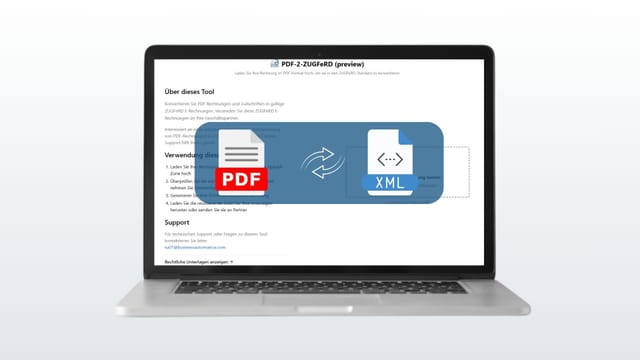
You don't have to wait for an ERP upgrade! An e-invoicing add-on can automatically convert your PDF invoices into XRechnung/ZUGFeRD—without changes to SAP, Navision, or other legacy systems. Implementation is possible in 2-4 weeks.
Solution options for legacy systems:
- Add-on/Middleware: Conversion between legacy formats and e-invoices
- API integration: Connection to existing print paths or export interfaces
- Parallel operation: Existing system continues to run; add-on handles e-invoicing
2. Supplier onboarding
Not all suppliers are ready for e-invoicing:
- Communicating requirements
- Providing test environments
- Support during the transition
3. Process adjustment
Existing workflows must be adapted:
- Mapping invoice fields
- Defining validation rules
- Staff training
Preparation checklist
- Inventory: Which systems create/receive invoices?
- Gap analysis: Which systems support e-invoices?
- Project planning: Timeline for the transition
- Pilot phase: Testing with selected partners
- Rollout: Phased introduction
- Monitoring: Overseeing processes
Conclusion
The e-invoicing mandate is not a burden, but an opportunity for digitalization. Companies that switch early will benefit from:
- More efficient processes
- Lower costs
- Better data quality
- Competitive advantages
The time leading up to 2025 should be used to carefully plan and implement the transition.