The future of artificial intelligence is no longer being written solely by algorithms in isolated data centers. Instead, an era is emerging in which AI agents are learning to improve themselves independently—directly through interaction with their users and developers. This evolutionary development promises not only more relevant results but also a profound personalization of digital assistants.
At a glance: AI agents like Minimax M2.7 and OpenClaw-RL are revolutionizing interaction by independently improving based on user feedback. This "self-evolution" leads to personalized, more efficient systems and marks a paradigm shift from static to adaptive AI models. Companies must now invest in governance and agile development to remain competitive.
The Silent Teachers: How Feedback Shapes AI
For a long time, AI models were deployed as static entities after extensive training phases, with their learning process ending upon deployment. Every user correction, every nuanced adjustment in dialogue, or every error message from a tool was lost as a valuable training signal. But this is now beginning to change. Researchers at Princeton University have introduced a fundamentally different approach with the OpenClaw-RL framework: every interaction becomes a continuous learning process.
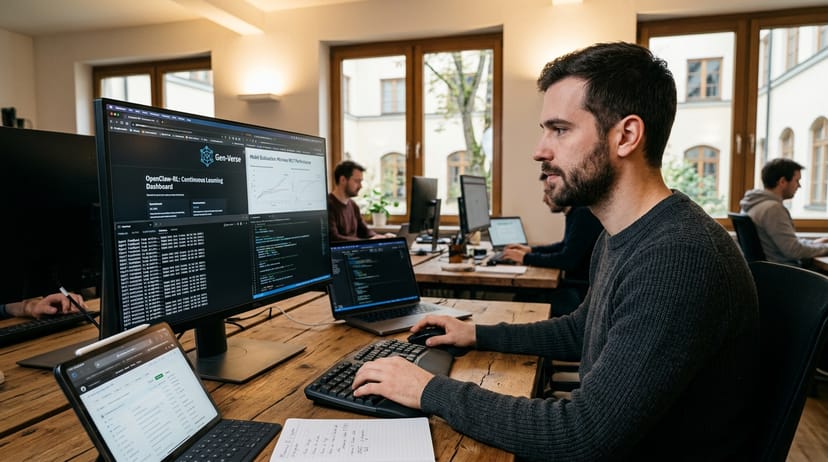
The system is a fully asynchronous Reinforcement Learning (RL) framework that continuously trains Large Language Models (LLMs) during live operation. It uses "next-state signals"—direct user responses, tool outputs, or changes in the graphical user interface—as real-time training data. These signals contain both evaluative information (whether an action was good or bad) and directive guidance on how the action should have been different. Through an asynchronous design, the agent can continue to process requests while training runs in the background, without downtime or batch processing. The OpenClaw-RL framework thus overcomes the "bottleneck problem" of modern agentic AI, where the separation of deployment and training led to a massive loss of valuable interaction data. For personal agents, this can mean that personalization performance improves significantly after just a few dozens interactions.
Minimax M2.7: The Self-Evolving Digital Engineer
Parallel to these developments, companies like MiniMax are pushing the idea of self-evolving AI models. Their latest model, M2.7, is the first to "deeply participate in its own evolution." It is capable of creating complex agent harnesses and solving highly complex productivity tasks by utilizing capabilities such as agent teams, complex skills, and dynamic tool searching. In the development process of M2.7, for example, the model was prompted to update its own memory and develop dozens of complex skills in its harness to support reinforcement learning experiments.
The model optimized its own programming performance by analyzing error histories and planning code modifications over iterative loops of 100 or more rounds. This process, in which M2.7 autonomously handled between 30 and 50 percent of its own development workflow, led to a 30 percent performance increase on internal evaluation sets. Skyler Miao, Head of Engineering at MiniMax, explained that the model was deliberately trained to plan better and clarify requirements with the user. The next goal is a more complex user simulator to drive this further. This capability extends to real-world software development, including end-to-end project delivery, log analysis, and troubleshooting. On the demanding SWE-Pro benchmark, M2.7 achieved 56.22 percent, which, according to MiniMax, is close to the best level of Opus.
Yan Junjie, founder of MiniMax, does not see his company as a "Chinese OpenAI" but is pursuing his own path. He emphasized in an interview that the model itself is the actual product, not just a channel. He predicts that the AI market in the office work sector will be even larger than in the programming sector, as the number of office workers far exceeds that of programmers.
Humans in the Loop: Trust and Governance
However, the increasing autonomy of AI agents also raises questions about governance and human oversight. Gartner predicts that the loss of control over AI agents that pursue misaligned goals or operate outside of constraints will be the top concern for 40 percent of Fortune 1000 companies by 2028. The Gartner "Market Guide for AI Governance Platforms 2025" emphasizes that AI governance is no longer optional but forms the foundation for scaling and trust.
This is where the concept of "Human-in-the-Loop" (HITL) comes into play, where humans are actively involved in decision-making. It ensures accuracy, safety, and ethical decisions, especially in high-risk environments like medical diagnosis. However, an HITL approach can be expensive and resource-intensive for real-time or high-frequency decisions. Therefore, experts see a transition to "Human-on-the-Loop" (HOTL), where the AI acts autonomously within defined guardrails and the human role shifts from operator to overseer. This approach makes it possible to avoid human bottlenecks in low-risk tasks while preventing uncontrolled autonomy in high-risk processes.
The need for robust governance structures is underscored by the rapid spread of AI: according to a Bitkom study from February 2026, 36 percent of German companies are already using AI—almost twice as many as the previous year. Another 47 percent are planning its use or discussing it. 81 percent of companies consider AI to be the most important future technology, and 51 percent believe that companies that do not use AI have no future. At the same time, the EU AI Act is viewed critically by 56 percent of companies, as it could create more disadvantages than advantages for German companies. Gartner predicts that by 2030, fragmented AI regulations will increase fourfold and cover 75 percent of the global economy, driving compliance spending to $1 billion. Companies that proactively establish responsible AI practices can turn compliance into a competitive advantage and gain the trust of customers, investors, and regulators.
Frequently Asked Questions
What does "self-evolution" mean for AI agents?
"Self-evolution" in AI agents describes the ability of AI systems to continuously and autonomously improve their learning process and way of working based on interactions with users, developers, and the environment. Models like Minimax M2.7, for example, can build their own research environments and optimize their programming performance by analyzing errors, allowing them to autonomously handle up to 50 percent of their own development workflow.
How do user interactions contribute to the improvement of AI agents?
User interactions provide "next-state signals"—direct feedback such as corrections, tool outputs, or changes in system state—which are processed by the AI in real time. Frameworks like OpenClaw-RL use these signals to continuously train and personalize the AI, eliminating the need for static datasets or manual annotations and achieving a significant improvement in personalization performance.
What practical steps should companies take to successfully introduce adaptive AI agents?
Companies should first establish clear governance frameworks that ensure human oversight (Human-in-the-Loop or Human-on-the-Loop) in critical decision-making processes. It is also important to invest in agile development practices that integrate continuous feedback into the AI lifecycle and to train employees in AI skills to fully exploit the potential of adaptive systems. What practical steps should companies take to successfully introduce adaptive AI agents?
Key Takeaways
- Adaptive AI Agents: Systems like Minimax M2.7 and OpenClaw-RL learn continuously from interactions and internal optimizations, steadily increasing their relevance and efficiency.
- Real-Time Feedback: Ignoring user feedback is a thing of the past; every interaction becomes a direct training signal, leading to rapid personalization and performance gains.
- Governance and Trust: Despite increasing autonomy, human oversight (Human-on-the-Loop) remains crucial to ensure trust, explainability, and compliance, especially in light of rising AI risks.
- First Step: Companies should start pilot projects with self-improving AI agents, implementing robust governance frameworks and feedback mechanisms from the outset to secure competitive advantages.
Sources: