AI Agents: Redefining Efficiency
The daily work routine of many sales professionals is characterized by a growing flood of information: emails, calendar entries, notes, and documents are scattered across a wide variety of systems. Making decisions requires tedious research, and meetings demand time-consuming preparation. As a result, valuable time slips away—time that is missing for strategic or creative tasks.
Information Overload as an Efficiency Brake
This challenge is not an isolated case. Especially in customer acquisition and project management, it becomes clear how strongly scattered information can impair workflow. The further a lead progresses through the pipeline, the more complex the information landscape becomes.
Emails, CRM entries, meeting notes, and calendar entries must be constantly reconciled to maintain an up-to-date overview. Many companies fall into a reactive stance as a result: decisions are made as soon as information becomes available—not when they are actually needed.
This leads to a paradoxical situation: although more data is available than ever before, the contextual connection that turns data into actual knowledge is often missing.
AI Agents: Digital Assistants with a Method
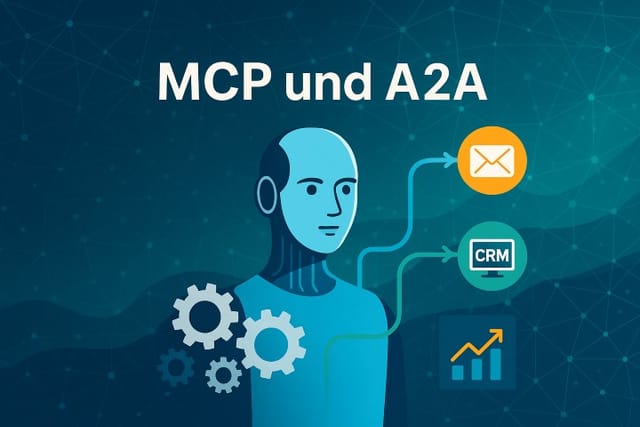
In recent years, the concept of the AI agent has developed into a viable solution. These are not futuristic robots or complex machines, but specialized software agents programmed toward a clear goal.
An AI agent works autonomously. It receives defined tasks, access to relevant data sources, and a methodical structure within which it makes decisions. It then continuously analyzes the current situation, derives the next logical step, executes it, and evaluates the result—until the predefined goal is achieved.
In a corporate context, such an agent can be deployed as a tireless digital assistant that analyzes data, assigns tasks, and provides relevant information without the need for human intervention.
From CRM System to Intelligent Lead Management Agent
A classic area of application is lead management. While conventional CRM systems primarily serve to manage customer data, they lack an understanding of the information contained within them. Automations—if present at all—are usually only implemented in rudimentary forms.
An AI-powered Lead Management Agent (LMA) takes it a step further: it classifies incoming emails, automatically assigns them to the appropriate projects or leads, and additionally analyzes calendar entries and meeting notes to independently derive relevant tasks.
The result is a dynamic overview of all sales-relevant processes—not as a static database, but as an intelligent, adaptive system.
What a Lead Management Agent can do
- Independently analyze the history of customer communication
- Recognize project phases and responsibilities
- Derive recommendations for action
- Automatically create or prioritize tasks
The administrative burden is significantly reduced, and sales work becomes what it should be: a strategic activity based on relationships and decision-making.
"Missed leads mean lost revenue. The Lead Management Agent ensures that no opportunity is lost—automatically, precisely, and in real-time."
Technology Follows Method
As fascinating as the technical possibilities are, the decisive success factor lies not in the technology itself, but in the methodical approach. An AI agent can only work effectively if the goal, framework conditions, and success criteria are clearly defined.
Therefore, before a system is developed or introduced, companies should answer three central questions:
- What is the goal? What concrete result should be achieved? Is it about saving time, transparency, or improving quality?
- What is the current state? Which processes and systems are currently involved, and where do bottlenecks and friction losses occur?
- Which solution is truly the right fit? Is an AI agent the right path—or is a simpler form of automation sufficient?
These questions form the foundation for any successful digital transformation.
The True Strength of AI: Context Instead of Complexity
Modern AI agents are characterized by the fact that they do not just manage content, but understand it semantically. They grasp what a piece of information means and the context in which it stands. This allows them to prioritize tasks based on context and provide recommendations for action—a capability that goes far beyond classic automation.
This relieves employees in several ways:
- Recurring routine tasks are reduced
- Information flows are structured and centralized
- Strategic and creative resources are freed up
AI does not replace experience or judgment—it merely creates the space in which these human qualities can become effective again.
Conclusion: Progress Through Exchange and Reflection
The integration of intelligent systems like AI agents can lead to a significant increase in efficiency. However, the true added value is created not by automation alone, but by a new way of thinking about how we handle information.
Those who view technology as a methodical partner, rather than an end in itself, regain the freedom to focus on what matters: decisions, strategies, and relationships.
Small and medium-sized enterprises, in particular, benefit when they combine technological innovation with a clear, reflected approach. Because progress happens where experience, methodology, and technology meet.