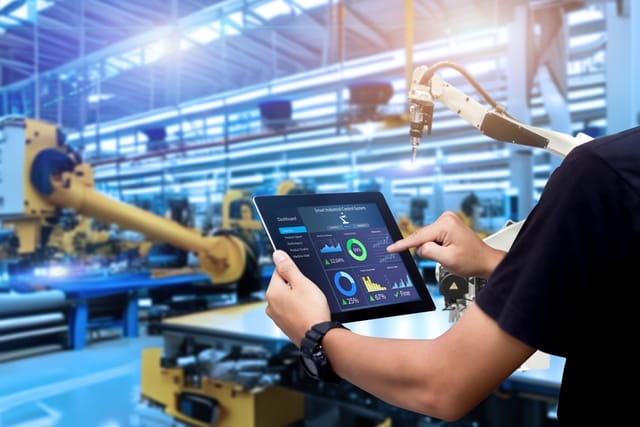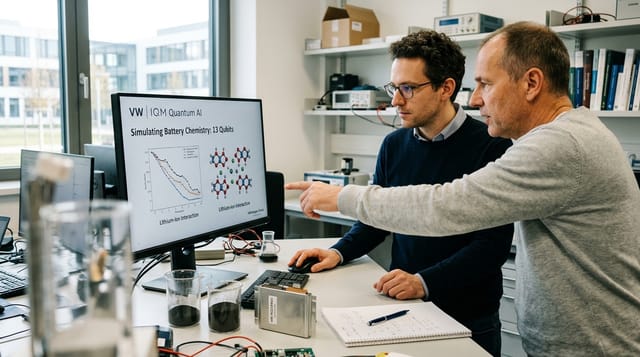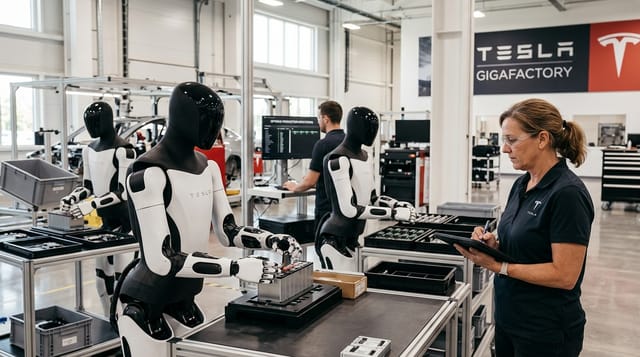
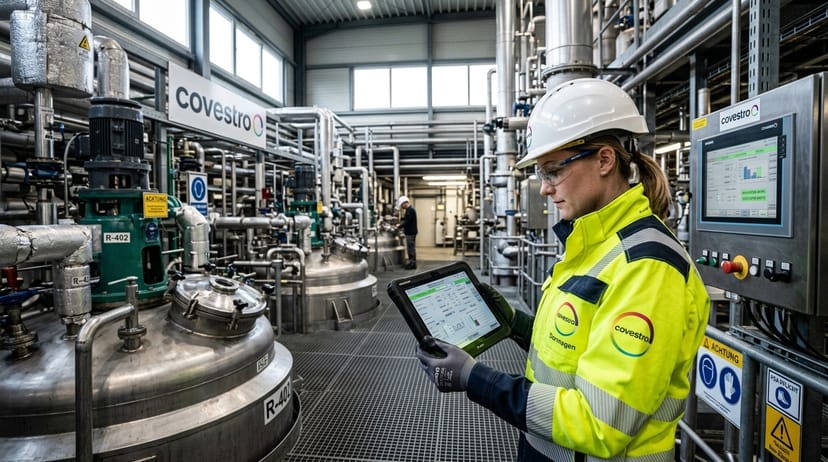
If you want to grasp the drama of the German chemical industry in the spring of 2026, you have to look to Dormagen. There, at the Covestro polyester plant in North Rhine-Westphalia, the machines hum with an almost eerie perfection [6]. It is a glimpse into the future of an industry that is fighting for its bare survival elsewhere. The contrast between state-of-the-art, AI-controlled algorithms and the empty factory halls in the rest of the country could hardly be sharper.
At a glance: In 2026, the German chemical industry is under enormous pressure due to historic lows in capacity utilization and geopolitical shocks. While corporations like Evonik are cutting jobs and BASF is relocating production, radical automation through artificial intelligence—as seen at Covestro—offers the decisive way out. The government is now attempting to counter this with the "Chemical Agenda 2045."
Red Alert at the Factory Gates
The raw figures presented by the German Chemical Industry Association (VCI) in March 2026 read like the diagnosis of a chronically ill patient. Capacity utilization in German chemical plants is stagnating at a mere 70 percent [5]. This is a historic low, far below the threshold at which plants can be operated profitably. In the fourth quarter of 2025, the revenue of the chemical-pharmaceutical industry shrank by another 0.6 percent to 51.8 billion euros, while chemical production itself plummeted by 3.3 percent [5].
"The industry is sending an SOS," states VCI President Markus Steilemann soberly. He notes that 2025 was another very difficult year, and the outlook is not getting any brighter [1]. His Director General, Wolfgang Große Entrup, is even more blunt, describing the annual balance sheet as "abysmal," as production, revenue, and prices are deep in the red [5]. After the change in government, the industry had hoped for much more.
In addition to crushing energy costs, a new, toxic factor emerged in March 2026: the escalating Iran conflict and the blockade of the Strait of Hormuz are driving prices for liquefied natural gas (LNG) and oil massively upward. The VCI is already warning of serious supply shortages for essential raw materials such as ammonia, phosphate, helium, and sulfur [1].
Job Cuts and Relocation
The reactions in the executive suites bear witness to an unvarnished drama. The pain threshold for energy costs was crossed long ago. As early as the end of 2024, industry leader BASF began shutting down production lines in Germany and shifting investments to China instead [4]. The US corporation Dow also drew consequences and announced the closure of three of its most energy-intensive European plants [7].
Meanwhile, at the Essen-based specialty chemicals group Evonik, management is pulling the ripcord with a tough restructuring program called "Tailor Made." By 2026, the company will cut 2,000 jobs worldwide [8]. Evonik CEO Christian Kullmann makes no secret of the gravity of the situation: "We must not fool ourselves, even if there are slight signs of recovery: what we are currently experiencing are not cyclical fluctuations, but massive, consequential changes in our economic environment" [8].
The Algorithm as a Lifeline
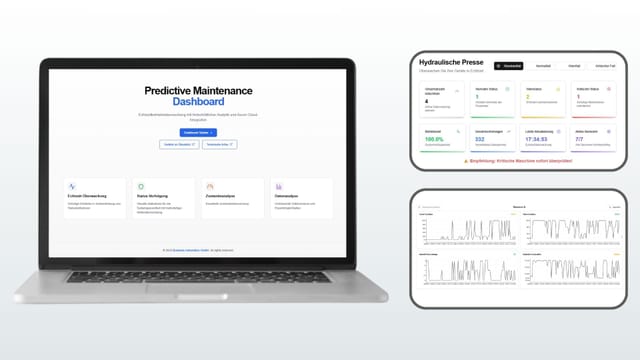
Yet, in the midst of this industrial struggle for survival, a remarkable technological awakening is taking place. Automation is transforming from a mere promise of efficiency into an existential necessity. In Dormagen, Covestro is proving that a turnaround is possible. Since February 2025, a production line there has been operated entirely autonomously by artificial intelligence [6]. From order intake and production planning to logistics preparation, no human intervention is required. The measurable result: higher production yield, reduced resource consumption, and drastically improved plant availability through early AI detection of deviations [6].
This "AI ramp-up" is not an isolated case. A study by the Fraunhofer Institute ISI from April 2025 confirms the rapid pace of this transformation. While only eight percent of companies in the chemical and pharmaceutical industry were using AI in 2022, another 13 percent joined them by 2025. Once the entry barrier is overcome, companies are massively expanding their usage, as highly complex chemical processes are ideal for machine learning.
The technology has also arrived in the daily engineering routine of 2026. Hans-Peter Zobl, CTO at SCIO Automation, observes the widespread use of Large Language Models (LLMs) to accelerate technical documentation and perfect predictive maintenance. Even Evonik, despite job cuts, is investing around 80 million euros annually in "Next Generation Technologies" to establish more energy-efficient processes and save the transformation [8].
Political Struggle for the Future
The looming collapse has finally put policymakers on high alert. At the end of March 2026, the German government, together with the industry, presented the "Chemical Agenda 2045." "The future of Germany as a chemical hub is being decided now," warned Federal Minister for Economic Affairs Katherina Reiche during the presentation. She called for an active and activating industrial policy as well as concerted consolidation.
The agenda includes, among other things, a state-subsidized industrial electricity price starting in 2026. To secure technological connectivity, Berlin is also pushing for the expansion of research clusters like "Chemistry & AI" and is planning, with EU partners, to establish an "AI Gigafactory" in Germany. However, the applause remains muted: economic representatives and state politicians from Hesse immediately criticized the measures as insufficient to resolve structural competitive disadvantages in the short term and to stop the exodus. The race between political regulation and technological reinvention thus remains the defining drama of the German chemical industry.
Frequently Asked Questions
Why is the German chemical industry in crisis?
The industry is suffering from a toxic mix of historically low capacity utilization of only 70 percent and crushing energy costs [5]. Furthermore, geopolitical shocks, such as the blockade of the Strait of Hormuz in the spring of 2026, are exacerbating the situation and driving prices for liquefied natural gas and essential raw materials massively upward [1, 9].
What role does artificial intelligence play in saving the industry?
AI has evolved from a "nice-to-have" to an absolute "must-have" to counter cost pressure. Companies like Covestro are already operating fully autonomous production lines that achieve higher yields and lower resource consumption through AI control [6]. According to the Fraunhofer Institute ISI, AI adoption in the industry is growing rapidly because complex chemical processes are ideal for machine learning.
How is the government responding to the threat of deindustrialization?
With the "Chemical Agenda 2045" presented in March 2026, the federal government is planning, among other things, the introduction of a state-subsidized industrial electricity price [12, 13]. At the same time, research clusters for "Chemistry & AI" are to be expanded, and a European "AI Gigafactory" is to be established in Germany to politically support the digital transformation of the industry [12, 14].
Key Takeaways
- Structural Crisis: In 2026, the German chemical industry is battling historically low utilization and massive geopolitical upheavals, leading to job cuts and site relocations.
- AI Transformation: The use of artificial intelligence is growing rapidly; according to Fraunhofer ISI, the share of chemical companies using AI rose from 8 percent in 2022 by another 13 percent by 2025.
- Autonomous Production: Practical examples like the fully autonomous plant at Covestro prove that AI-controlled processes can drastically increase profitability and plant availability [6].
- First Step: Companies must now invest heavily in automation and "Next Generation Technologies" to counter cost pressure through maximum process efficiency.
Sources: