Refrigeration Technology: AI App Ends Paperwork Chaos
Isolated software and paper logs cost refrigeration engineers valuable time. An offline-capable app automates data collection.
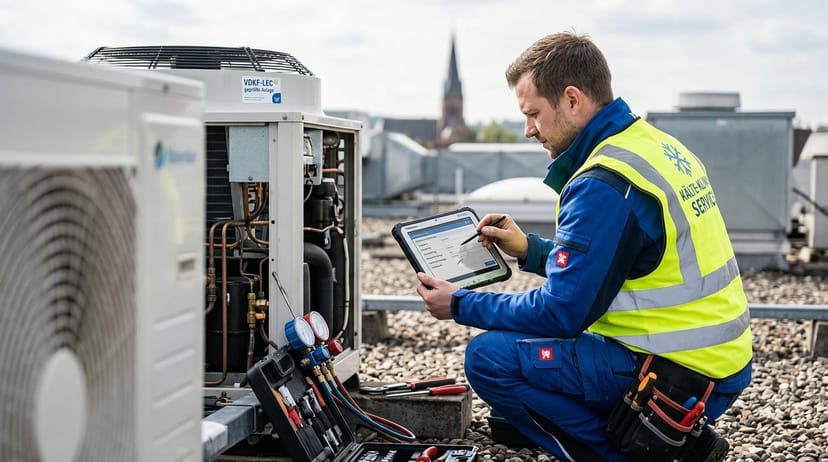
It is a familiar sight on rooftops and in dimly lit technical rooms: the service technician notes pressure and temperature values on a soggy notepad, flips through printed equipment histories, and laboriously types everything into the database in the evening. Paper logs, handwritten maintenance reports, and duplicate data entry rob refrigeration and HVAC companies of valuable hours every day. But this is exactly where a technological shift is taking place. An AI-powered maintenance app puts an end to the paperwork chaos directly on-site and elevates service to a new level.
At a glance: Digitalization in refrigeration engineering often fails due to isolated software solutions and duplicate data entry. An integrated, offline-capable maintenance app connects technicians directly with systems like VDKF-LEC. Companies save massive amounts of time, reduce error rates, and noticeably accelerate their billing processes.
The Battle Against the Software Patchwork
According to the "Digitalization in the Trades 2024" study by the German Confederation of Skilled Crafts (ZDH), while 68 percent of companies already use digital technologies, the reality on the ground is often sobering. As the trade magazine SHK Profi reports using the example of GBS Kühlanlagen GmbH, confusing patchwork structures of isolated micro-solutions often grow over the years. The technician uses one app for time tracking, another for photos, and in the end, the actual maintenance report is still manually transmitted to the office.
Our solution breaks down these data silos. Technicians log in easily via smartphone, tablet, or laptop. Customer, location, and equipment data are already pre-filled. The application works reliably even deep in a basement or in a shielded server room: all data is stored locally offline and synchronized fully automatically as soon as the device has a signal again. This fundamentally accelerates the service order and relieves customer service from annoying follow-up questions.
The End of Quadruple Data Entry
The example of Airtec Service GmbH shows just how high the level of frustration is in practice. In a report by the trade journal Kälte Klima Aktuell, management describes the former daily routine of their sixteen technicians in stark terms: for every job, checklists, work orders, and timesheets had to be maintained in paper form. The work was sometimes recorded three or four times in the field before it finally landed in the system.
By switching to an integrated mobile solution, this effort is a thing of the past. Master data from previous reports is now automatically transferred to the current checklist. Measured values flow directly into the digital log. In the future, this data can even be read out fully automatically from digital measuring devices or IoT systems of the refrigeration units. For modern companies, this paperless approach has long been a tangible argument in the battle for skilled workers. Anyone looking to recruit mechatronics technicians for refrigeration technology today must promote digital processes instead of paperwork to remain competitive in the labor market.
VDKF-LEC and Refrigerant Compliance
A massive time-waster in the refrigeration industry is the legally required documentation of fluorinated greenhouse gases. According to the EU F-Gas Regulation, operators and specialist companies must keep complete logbooks, which the Facility Management Magazin highlights as a central operator responsibility and legal risk. The industry software VDKF-LEC is the absolute standard here: according to a current analysis by cci Dialog GmbH, it is now used to manage over 265,000 refrigeration and air conditioning systems for more than 1,100 specialist companies in a legally compliant manner.
However, a dangerous media break often occurs here as well in everyday life, when technicians record leak checks on paper first and transfer them to the system later. A modern app infrastructure solves this problem elegantly via direct interfaces. The quantities of refrigerants recorded on-site, repairs performed, and leak tests are transmitted seamlessly to the VDKF database without manual double entry. The traditional analog paper logbook cited by cci Dialog GmbH has thus finally become obsolete. All maintenance data can also be exported for official audits at any time.
Faster Billing, Secure Scaling
When the digital maintenance report, including customer signature and material consumption, arrives in the office in real-time, the entire commercial rhythm of a company changes. Invoicing can take place immediately instead of waiting days or weeks for the technicians' paperwork. Automated billing, including modern e-invoices, dramatically improves the company's liquidity and minimizes sources of error during transmission.
The solution can be flexibly adapted to your specific workflows. You relieve your technicians of administrative burdens, accelerate your service, and create a foundation for a modern, digital operation. In the end, less paper simply means: more efficiency and a better future for your company.
Frequently Asked Questions
Why is an offline function indispensable for maintenance apps in refrigeration technology?
Refrigeration and air conditioning systems are often located in basements, shielded technical rooms, or on roofs with poor network coverage. True offline capability ensures that technicians can record all measured values and checklists without gaps; the app stores the data locally and synchronizes it automatically in the background as soon as an internet connection is available again.
How does the app reduce the effort involved in VDKF-LEC documentation?
Instead of noting leak checks and refrigerant quantities on paper first and typing them in later, this data is recorded digitally directly at the unit. Through standardized interfaces, the information flows seamlessly into the VDKF-LEC software, which eliminates duplicate data entry and automates the legal reporting obligation according to the EU F-Gas Regulation.
What is the best way to switch from paper to a digital solution?
Start with a pilot project for a small team of technicians and first digitize the most frequently used standard maintenance protocols. As soon as acceptance grows due to noticeable time savings in data entry, you can gradually roll out more complex processes such as automated billing and direct measuring device integration.
Key Takeaways
- Central Data Basis: An integrated app ends the software patchwork and bundles time tracking, reports, and equipment history into a single application.
- Refrigerant Compliance: Direct interfaces to systems like VDKF-LEC eliminate error-prone, duplicate data entry when documenting greenhouse gases.
- Liquidity Advantage: Digital maintenance reports transmitted to the office in real-time enable immediate, automated invoicing.
- First Step: Analyze your current paper processes and define the three most time-consuming documentation requirements for your technicians to prioritize them for digitalization.