Tesla Optimus: Humanoid Robot Mass Production at Giga Texas
Tesla is building a factory for up to 10 million Optimus robots annually. This paradigm shift promises to fundamentally change the world of work.
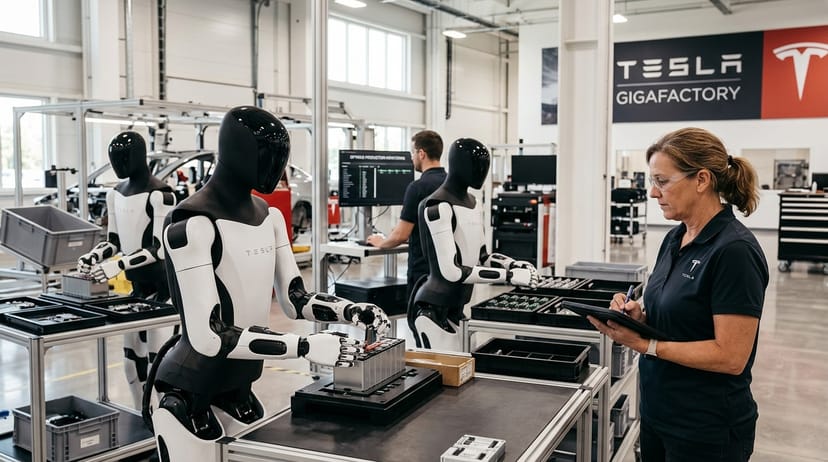
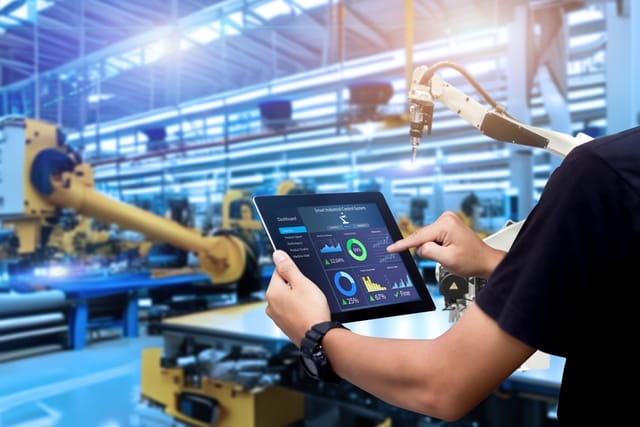
In the sprawling halls of Giga Texas, where electric vehicles usually roll off the assembly line, a different vision is taking shape: Tesla is building a factory for humanoid robots. Construction has begun on a production facility capable of manufacturing up to 10 million "Optimus" robots annually, signaling Elon Musk's determination to make the humanoid robot the company's largest product. This is more than just an expansion; it is a paradigm shift that could fundamentally change the world of work as we know it.
At a glance: Tesla's humanoid robot, Optimus, is on the verge of mass production, aiming to revolutionize industries like logistics and manufacturing with a target price of under $20,000. Experts predict explosive market growth and profound disruptions in the labor market, while Germany still has some catching up to do in international comparison. Companies should monitor this development closely and develop strategies for integrating autonomous systems.
Optimus: More than a robot – a vision for industry
Elon Musk, the controversial visionary at the helm of Tesla, has called "Optimus" the "greatest product of all time." His ambition is to create a universal, autonomous humanoid robot that "takes over all the tasks that humans prefer to avoid"—whether they are dangerous, repetitive, or simply boring. The latest generation, Optimus Gen 3, is expected to be deployed in Giga Texas logistics operations as early as 2026 to transport battery cells and perform quality control checks at five times the speed of a human. A price target of around $20,000 makes it attractive to companies, with estimates suggesting the investment could pay for itself within just a few months.
The market for humanoid robots is indeed poised for explosive growth. While its value was estimated at $4.49 billion in 2025, an average annual growth rate (CAGR) of 50.60 percent is expected through 2034. Mordor Intelligence even forecasts an increase to $34.12 billion by 2030, driven by falling hardware costs for AI, aging populations in G7 countries and China, and the growing labor shortage in the industrial sector. Venture capital investments of over $4 billion in 2024 and 2025 underscore the confidence in this technology.
The disruptive power of "Physical AI"
The integration of AI into physical systems is described by a Commerzbank study as "Physical AI," a technological megatrend with disruptive potential. Humanoid robots are at the forefront of this development because they can operate in human environments and utilize existing infrastructure without requiring extensive modifications. This opens up broad fields of application in production, logistics, services, and, in the future, private households.
The advantages are clear: Humanoid robots can work up to 22 hours a day, 7 days a week—more than four times as long as a human. They are predestined for physically demanding, dangerous, or monotonous tasks, such as those found in night shifts or heavy lifting. Mercedes-Benz is already using humanoid robots in its Berlin plant, which underscores the practical relevance of this technology.
However, this disruption also brings challenges. According to an SEO.ai study, 14 percent of employees have already lost their jobs due to robots. Futurist Pero Mićić of the FutureManagementGroup AG emphasizes that this change is necessary to avoid severe crises and outlines scenarios for society where robots work more cheaply and learn faster than humans.
Challenges and the German perspective
Despite the hype, there is also skepticism. Critics have pointed out that some earlier Optimus demonstrations relied on teleoperation rather than full autonomy. Stefan Lampa, CEO of Proglove and former manager at ABB and Kuka, expressed criticism in an interview, labeling humanoid robots as "completely useless in a car factory." He argues that specialized robots are more efficient in many cases. However, humanoid robots can also take on entirely different tasks by downloading new skills, which increases their flexibility.
Germany is still lagging behind in the international commercialization of humanoid robots. A market analysis by Nexery shows that 45 percent of companies in this sector are from China and 27 percent from the USA, while Germany counts only a single active company. The German market for humanoid robots is expected to reach a volume of $0.2 billion by 2026.
For widespread use, especially in safety-critical applications, the development of "Explainable AI" (XAI) is essential, as Dr. Eric Maiser from the VDMA highlights. The International Federation of Robotics (IFR) sees humanoid robots as a complement to existing robot types, not a replacement. The decisive differentiator in humanoid robotics will be the software that enables robust, scalable, and adaptively learning systems.
Frequently Asked Questions
What is the Tesla Optimus robot and what tasks is it intended to perform?
The Tesla Optimus is a humanoid robot being developed by Tesla to automate physical, repetitive, and potentially dangerous work. It is intended to take over tasks in factories such as transporting battery cells and performing quality control, but in the long term, it will also be deployed in logistics, services, and households.
How large is the market potential for humanoid robots and what factors are driving it?
The market for humanoid robots is estimated at around $4.82 billion in 2025 and is expected to grow to $34.12 billion by 2030, representing an annual growth rate of 47.9%. Key drivers include falling costs for AI hardware, aging populations, and the increasing labor shortage in the industrial sector.
What disruptions are to be expected from humanoid robots in the labor market and how can companies react?
Humanoid robots are expected to take over many manual and repetitive tasks, which may lead to job losses; according to one study, 14% of employees have already lost their jobs due to robots. Companies should invest early in developing strategies for integrating autonomous systems, provide further training for employees, and focus on new roles that require human strengths such as creativity and complex problem-solving.
Key Takeaways
- Market Potential: The market for humanoid robots is growing rapidly and is expected to exceed $34 billion by 2030.
- Cost Efficiency: With a target price of $20,000 and the ability to work 22 hours a day, a Tesla Optimus could pay for itself in just a few months.
- Workplace Transformation: Humanoid robots will take over repetitive and dangerous tasks, leading to profound changes in the labor market, but also creating new jobs focused on human strengths.
- First Step: Companies should analyze the potential of humanoid robotics for their specific use cases and consider pilot projects in areas with high labor shortages or monotonous tasks.
The vision of a world where humanoid robots work alongside us is no longer distant science fiction. With Optimus, Tesla is driving the industrialization of this technology and forcing us to think about fundamental questions regarding work, the economy, and society. It is a development that goes far beyond technical specifications and has the potential to lead humanity into a new era—an era in which the boundaries between human and machine are redefined. The question is no longer whether these robots are coming, but how we prepare for their arrival.
Sources: