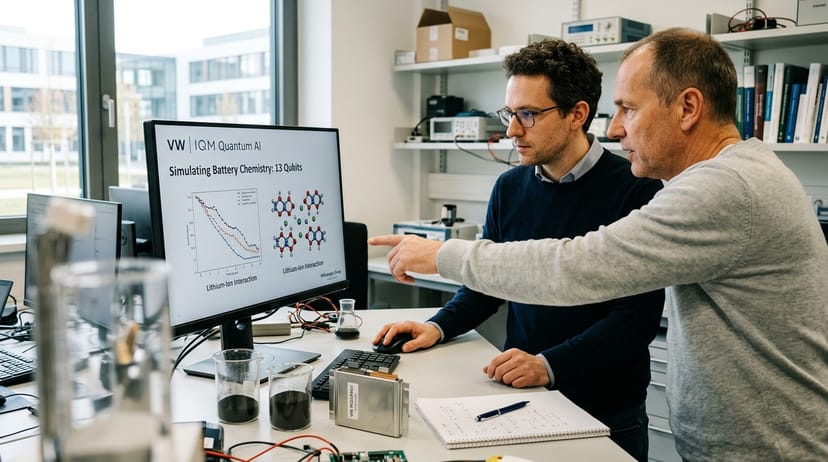
The moment theory gives way to practice can often be pinpointed by a single number. In the world of quantum computing, this number was long a distant promise, but in November 2024, researchers from Volkswagen and the Finnish-German startup IQM marked a turning point: with just 13 qubits, they succeeded in simulating chemical reactions in lithium-ion batteries with a precision that would have previously required multiple times the computing power using classical algorithms [1]. This marks the end of the era of pure basic research. The German industry is entering the phase of "utility scale"—practical usefulness [2].
It is no longer just about faster computers. It is about the symbiosis of two megatrends: Quantum Computing (QC) and Artificial Intelligence (AI). This convergence, often referred to as "Quantum AI," promises to break the boundaries of classical data processing [2]. While conventional AI models increasingly hit energy and time limits when training massive datasets, quantum algorithms could shorten this process from weeks to hours [2].
At a glance: Quantum computing is reaching industrial maturity and, through its combination with AI (Quantum Machine Learning), is revolutionizing materials research and logistics. German companies like VW, BMW, and BASF are already using the technology for concrete optimizations. To remain competitive, decision-makers should invest in pilot projects and skilled personnel now.
Batteries and Airport Gates: The Precision of the Impossible
The fields of application in Germany's core industry are as diverse as they are complex. At Volkswagen, quantum AI is being used to increase chemical accuracy in battery simulations, which could accelerate the development of more powerful electric drives [1]. The team employed a hybrid method, the so-called Auxiliary-field Quantum Monte Carlo algorithm, which outperformed even the previous "gold standard" of classical calculations [1].
The BMW Group is pursuing similar ambitions. Together with NVIDIA and Classiq, the automaker is working to perfect the electrical and mechanical architectures of future vehicle generations [3]. This involves the simulation of cooling systems and powertrains, but also mundane factory efficiency: the route planning of robots on the shop floor is being elevated to a new level by quantum algorithms [3]. Since AI in the German automotive industry: Strategic Imperative is already increasing efficiency today, the integration of quantum technologies is the next logical step.
An example from the aviation sector shows how drastically combinatorial complexity can increase in industry. Lufthansa Industry Solutions, together with the University of Hamburg, developed algorithms for "Airport Gate Assignment" [2]. What sounds simple is a mathematical nightmare: with just 15 gates and 10 aircraft, there are already over 570 billion possible combinations [2]. A classical computer takes too long to find the optimal solution; a quantum computer solves such problems with an elegance known in the industry as "Quantum Advantage."
Billion-Dollar Values and the German Balancing Act
The economic potential of this technology is enormous. McKinsey forecasts a value creation of up to 2 trillion US dollars by 2035 for the core markets of chemicals, pharmaceuticals, mobility, and finance [2]. Germany has recognized the signs of the times and is investing heavily: with 5.2 billion US dollars in public funding, the Federal Republic ranks second globally, surpassed only by China [2].
However, behind the glittering figures of the investment programs lies a paradoxical mood in the German economy. According to a 2026 Bitkom study, 64 percent of companies are currently pursuing a "follower strategy"—they are waiting to see what the pioneers do [2]. Although two-thirds of companies see quantum computing as a strategic opportunity, the hurdles are high [2]. 65 percent of companies complain about a massive shortage of skilled workers, which makes entering the technology difficult [2]. Given the current Chemical industry in crisis: AI as a way out, many companies are looking for ways to regain ground through technological innovation.
Furthermore, an existential concern looms: 94 percent of respondents identify IT security risks due to QC [2]. The catchphrase "Harvest now, decrypt later" describes the danger that encrypted data stolen today could be effortlessly cracked by quantum computers in a few years [2].
The Democratization of Quantum Power
To accelerate the transfer from research to small and medium-sized enterprises (SMEs), new infrastructures are currently being created. In 2025, the Fraunhofer lab "flaQship" was established in Heilbronn as a center for application-oriented quantum AI [4]. At the same time, the Fraunhofer Institute launched the open-source software "AutoQML" [2]. It is intended to enable companies to use quantum machine learning for tasks such as price forecasting or image recognition without requiring deep expert knowledge in quantum physics [2].
The big players are also creating platforms. NVIDIA announced the construction of the first industrial AI cloud platform in Germany for November 2025 to support automakers like BMW and Mercedes-Benz in simulating product designs [2]. Siemens is taking a similar path, integrating "Quantum-as-a-Service" from partner Terra Quantum into its Digital Twin Marketplace [5]. Engineers can easily access quantum-supported simulations for autonomous drone networks or vehicle systems there [5]. Those who are already relying on Predictive Maintenance - Benefits and Application Examples are laying the foundation for the data-driven factory of the future.
The example of Terra Quantum shows that genuine global market leaders can emerge from these developments. The German-Swiss startup announced plans in April 2026 for an IPO via SPAC, with a valuation of 3.25 billion US dollars [6]. It is a signal to the market: quantum computing is no longer a laboratory experiment, but a business model.
A Turning Point for Innovation
"Quantum computing has the potential to redefine innovation in every sector," emphasizes Robert Bruckmeier, General Manager Computing at the BMW Group [3]. Isabell Gradert from Airbus also clearly sees the technology on its way to industrial application [2]. For the German industry, this means a phase of upheaval. "Vorsprung durch Technik" (Advancement through technology) will in the future no longer be measured solely by mechanical precision, but by the ability to use the laws of quantum mechanics to optimize supply chains, discover new materials, or secure digital sovereignty.
Dr. Ralf Wintergerst, President of Bitkom, puts it in a nutshell: companies no longer need lofty visions, but "tangible entry aids" [2]. The toolkit for this is now filled—from cloud platforms to open-source software. The question for German industrial companies is no longer whether quantum AI is coming, but who will be the first to turn it into a measurable competitive advantage.
Frequently Asked Questions
What is the concrete advantage of Quantum Machine Learning (QML) over classical AI?
QML uses quantum algorithms to massively accelerate the training of complex models, such as Large Language Models (LLMs). While classical systems hit their limits with huge datasets, quantum computers can shorten calculations from weeks to a few hours and increase precision in materials research [2].
Which German industries benefit most from quantum computing?
The automotive industry (battery simulation at VW, architecture optimization at BMW), the chemical sector (logistics at BASF), and logistics (gate assignment at Lufthansa) are already achieving initial measurable results today [2][1][7][3]. McKinsey estimates the value creation potential in these core markets at up to 2 trillion USD by 2035 [2].
How can medium-sized companies without their own experts enter the technology?
Companies can rely on open-source solutions like "AutoQML" from the Fraunhofer Institute, which enable the use of quantum AI without deep expert knowledge [2]. Additionally, platforms like the Siemens Digital Twin Marketplace offer "Quantum-as-a-Service" to calculate complex simulations via the cloud [5].
Summary
- Quantum AI: The combination of quantum computing and AI drastically shortens model training times and increases research accuracy [2].
- Market Potential: With 5.2 billion USD, Germany is the second-largest investor in this technology worldwide, while McKinsey forecasts a global potential of 2 trillion USD [2].
- Security Risk: 94% of companies see QC as a risk to current encryption methods ("Harvest now, decrypt later") [2].
- First Step: Use existing open-source tools like AutoQML or cloud offerings from Siemens and NVIDIA for initial pilot projects [2][5].
Sources:
About Business Automatica
Business Automatica reduces process costs by automating manual tasks, improves quality in data exchange within complex system architectures, and connects on-premise systems with modern cloud and SaaS architectures. Applied artificial intelligence in the enterprise is an integral part of this. Additionally, Business Automatica offers cybersecurity-focused automation solutions from the cloud.